Two Twin Duvets on One Bed

Two twin duvets on one bed means each person has a separate top layer on a shared mattress. You stop negotiating one cover. The fit only works when the two duvets, placed side by side, match the mattress in both width and length. On a standard King, that is two Twin XL duvets, not two standard Twins.
A Twin mattress is 38 inches wide and 75 inches long. A Twin XL is 38 inches wide and 80 inches long. A King is 76 inches wide and 80 inches long. Two Twin XL widths add to 76 inches, and the length matches the King. Two standard Twins add to the same 76-inch width and stop at 75 inches, so the foot of an 80-inch King stays bare.
Which bed two twin duvets actually cover
The label on the duvet has to match the mattress you are covering, not the word "twin" alone.
King
Two Twin XL duvets are the pair that lines up with a King. Width adds to 76 inches. Length is 80 inches on both the mattress and each duvet. You still want a little overhang so the edges do not look clipped. A duvet is usually cut larger than the mattress it is named for, which is what creates that drop. Bare Home's Twin and Twin XL cut measurements are not in the facts file.
Queen, Full, and California King
A Queen is 60 inches wide and 80 inches long. Two Twin XL duvets at 76 inches wide will hang well past the sides. That can work if you want extra drape and you do not mind the center overlap. It is a poor match if you want each duvet to end at the mattress edge.
A Full is 54 inches wide and 75 inches long. Two standard Twins are closer in length and too wide. A California King is 72 inches wide and 84 inches long. Two Twin XL duvets are a bit wide and four inches short at the foot. None of those three is the clean case. King is.
Split King
A Split King is two Twin XL mattresses. Two Twin XL duvets match that setup one to one, and each side can move if the base adjusts. Sheets are a separate problem. A Split King usually needs two Twin XL fitted sheets, not one King fitted sheet. Pocket depth still has to match the stack: Standard for 7 to 14 inches, Deep for 15 to 17, Extra-Deep for 18 to 25 or more. Measure mattress plus protector plus topper before you buy the sheets that go under the two duvets.
What changes when you stop sharing one duvet
The point is temperature and tug, not a second decorative layer.
Heat and the cover hog
One person can use a lighter duvet and the other a warmer one. One can fold theirs down without uncovering the other. That is the whole mechanism. A shared King duvet cannot do it, because moving the cover moves it for both of you.
The cost is a gap. Two separate duvets meet in the middle and do not seal. On a cold night the gap is where the draft comes in. Overlap them by a few inches at the center, or accept a thin throw across both feet. A throw will not fix a large temperature difference. It only closes the seam.
Making the bed
Each duvet gets its own cover, or each comforter is used as a finished top. You make two narrower beds on one mattress. The center edge is the part that looks unfinished if the two pieces are different lengths or different colors. Matching covers read as one bed from the door. Different weights can still hide under matching covers.
Wash one cover at a time if you want. The other stays on the bed. That is a real gain if you only own one King cover and it is always in the hamper on laundry day.
Insert and cover, or two comforters
You can build the pair two ways. The wash difference is the reason to pick.
Two inserts and two covers
An insert is the fill. The cover is the washable shell. Buy two Twin XL inserts and two Twin XL covers. Ties or a zipper keep the fill from sliding, which matters more on a narrow duvet because there is less fabric to hide a lump. The Ultra Soft Down Alternative Duvet Insert is the fill only, cover separate, with loops for the cover. The Ultra-Soft Duvet Cover Set is the shell plus shams, insert not included. Order the Twin XL size of each, twice.
More covers, if you want a different fabric on one side, are in duvet covers. Inserts are in duvet inserts.
Two comforters, no covers

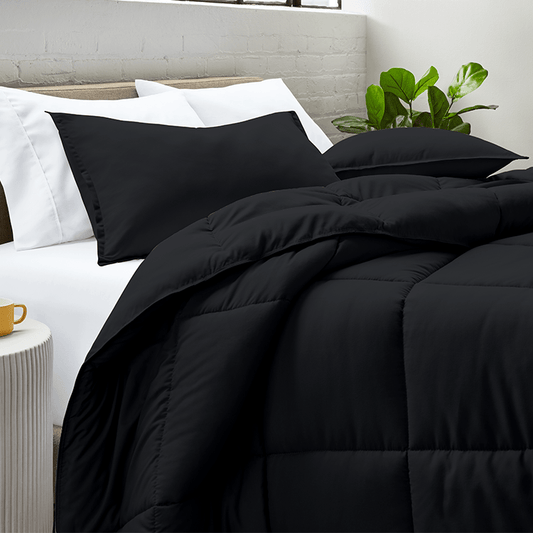
A comforter is fill and shell in one piece. You sleep under it as-is. Two Twin XL comforters skip the stuffing step. You wash the whole piece when it needs it, so laundry is bulkier. The Ultra Soft Down Alternative Box Stitch Comforter Set is that finished piece, with a sham, in Twin and Twin XL. Use it if you do not want to wrestle a cover onto a narrow insert. Use the insert-and-cover pair if you want to wash the layer that touches you without washing the fill every time.
Sheets stay one set for the mattress size. Two twin duvets do not mean two twin fitted sheets, unless the bed is a Split King. A King mattress still takes King sheets. Those are in sheets.
The short version
Two Twin XL duvets match a King. Each is 38 by 80 inches of mattress coverage. Side by side they make 76 by 80, which is King width and length.
Two standard Twins fall short on a King. They add up in width and stop at 75 inches, five inches short of an 80-inch King.
Queen, Full, and California King are the wrong match. Two Twin XL duvets are too wide for a Queen or Full, and too short for a California King.
Each person gets their own weight. One light duvet and one warmer duvet is the reason to split. A shared King duvet cannot do that.
Overlap the center. Separate duvets leave a gap. A few inches of overlap, or a throw at the feet, is what closes it.
Covers wash easier than comforters. Two inserts plus two covers let you wash the shell. Two comforters skip the cover and wash as one piece.
Shop The Products We're Talking About


Keep Reading
How to Layer Bedding Properly
Down vs Down-Alternative Inserts When Nights Drop