How to Layer Bedding Properly

You layer a bed properly from the mattress up: protector, fitted sheet, flat sheet, a light blanket you can push down, then a duvet or comforter. Decorative pillows and a throw at the foot come off at night. That split, between what the bed looks like and what you sleep under, is the whole method.
1. Layer a bed properly from the mattress up
Start with height, not color. A fitted sheet fails when the pocket is shorter than the stack, and the stack is mattress plus protector plus any topper.
Bare Home sorts pockets in three bands. A Standard Pocket fits 7 to 14 inches. A Deep Pocket fits 15 to 17 inches. An Extra-Deep Pocket fits 18 to 25 inches, or more, including a pillow-top or a thick topper. Measure the made stack with a tape at the side, from the bottom edge of the mattress to the top surface you will sleep on. If you skip the protector in that measurement, the sheet will look fine on day one and pop a corner after the first wash.
A protector sits under the sheet. It is the layer you wash least often, and it is there so spills and skin oils do not reach the foam or coils. A pad is a different object: it adds a thin cushion. If you use both, both count toward pocket depth. Sheets are in the sheet collection. Deep stacks are in extra-deep pocket sheets. Pads and protectors are separate: mattress pads and protectors.
Pull the sheet on and run a hand along the side. The elastic should sit under the corner, not halfway up the wall of the mattress. If the band is stretched tight across the corner, the pocket is too shallow for that stack.
2. Lay the flat sheet finished-side down
The flat sheet is the layer against your skin if you use one. Lay it with the finished side down, hem at the top, so the nicer face ends up against you when you fold the top back. Leave enough length at the head to fold over the blanket, about 12 to 18 inches. That fold is what people mean by a hotel fold. It shows the sheet and keeps the blanket edge off your chin.
You do not have to use a flat sheet. Some people sleep with a duvet cover as the washable layer and skip the flat. The tradeoff is laundry. A flat sheet is lighter to wash than a duvet cover, and you can change it without wrestling an insert. If you skip it, the next fabric up has to be something you are willing to wash on the same schedule as a sheet.
Cotton percale is a plain weave, one thread over, one under. That grid is why it feels crisp and why it wrinkles. Sateen floats several threads over one, which is why it feels smoother and a bit warmer. Linen is flax, usually in a plain weave, and it starts textured.
Tuck the sides if you like a tight bed. Leave them loose if you turn over a lot. The tuck is preference. The finished-side-down rule is the part that changes how the fold looks in the morning.
3. Add a blanket you can kick off

The middle layer is the one you actually adjust at 2 a.m. A light blanket or quilt between the sheet and the duvet gives you a step down in warmth without pulling the whole top layer off.
Put it on after the flat sheet, centered, with the same overhang on both sides. If it is wider than the duvet, it will show as a stripe along the edge and the bed will look unfinished. If it is much smaller, it will not cover your feet when you use it alone. A throw is too small for this job. A throw belongs at the foot. The middle layer should cover the mattress top at least.
This is the part that trips people up. A styled bed often has three warm layers stacked because the photo needs volume. You sleep under one or two. In a warm room, the blanket alone may be enough, and the duvet stays folded at the foot. In a cold room, the blanket stays under the duvet as a buffer so you are not choosing between a sheet and a heavy top layer. Warm-sleeper options are grouped in the hot sleeper collection.
Wash this layer more often than the duvet and less often than the sheet, because it touches you only when the sheet is folded back or kicked down.
4. Set the duvet for drape, not for a photo
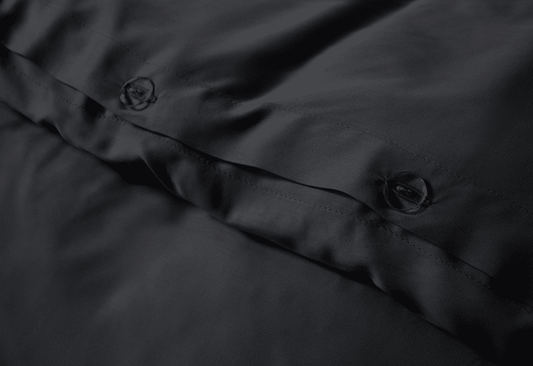
A duvet is an insert inside a cover. A comforter is the filled blanket itself, usually with no separate cover. Both can be the top layer. They are not the same laundry job. A cover comes off and goes in the washer. A comforter is heavier and slower to dry.
For drape, the top layer needs to cover the mattress top and hang past the side. A skimpy top layer is why a bed looks flat even when the pillows are fine. Many brands sell one King and California King cover, because a King mattress is wider and shorter (often 76 to 78 inches wide and 80 inches long) and a California King is narrower and longer (72 by 84 inches). That shared label is normal for covers and a bad idea for fitted sheets. Check the cover's listed cut against your mattress before you assume the hang will match.
An insert that is a few inches larger than the cover fills the corners and reduces empty pockets. An insert that is much larger bunches. Ties or a zipper keep the insert from migrating. Covers and inserts are separate: duvet covers and duvet inserts. If you want one filled piece instead of a cover, use comforters and quilts.
Shake the insert before you button or zip the cover. Smooth from the center out. Fold the top third down if you want the sheet and blanket visible. Leave it up if you want a simpler bed. Both are correct. The fold is styling. The drape is fit.
5. Park a throw at the foot
A throw at the foot is optional. It adds a layer you can pull up over your legs without committing the whole bed to a heavier top. It also hides the point where the duvet stops, which is why styled photos always include one.
Lay it across the foot, folded in half or thirds, so it spans most of the width. A throw that covers only the center looks like laundry. A throw that reaches the floor on both sides hides the bed frame, which you may or may not want. Pull it off, or down to the foot, before you get in. Sleeping under a decorative throw plus a duvet plus a quilt is how a styled bed becomes too warm.
Throws and blankets are in blankets and throws. Every Bare Home item is OEKO-TEX Standard 100 certified. That certification covers harmful substances tested to the standard. It is not a warmth rating, and it is not a claim about how a throw feels.
If the room is already warm, skip this layer. An empty foot of the bed is fine.
6. Stack pillows by job, then remove the extras
Pillows have two jobs. Sleeping pillows stay on the bed. Decorative pillows come off.
Sleeping pillows go against the headboard, in cases you wash with the sheets. Shams are the cases with a flange or an overlap back. People use them on the pillows that show. A Euro sham is the square one, typically about 26 by 26 inches, and it sits behind the sleeping pillows to make the head of the bed look taller. Two sleeping pillows per person is enough for the night. Euros, lumbars, and small accent pillows are the styled row. Take that row off and put it on a bench or a chair. If you leave four decorative pillows on the bed, you will push them to the floor anyway.
Cases and shams are in pillowcases and shams. Match the case size to the pillow insert, not to the mattress size. A Queen bed often still uses standard pillows.
Fluff the sleeping pillows. Leave the decorative ones out of the wash cycle unless the cover says otherwise.
Bringing it together
You do not need every layer every night. A warm night is protector, fitted sheet, flat sheet, and the light blanket. A cold night adds the duvet, with the throw still at the foot until you reach for it. The styled version, with the hotel fold, the throw, and the Euro shams, is a morning reset. It is not a second comforter.
If the fitted sheet will not stay on, remeasure the stack before you buy another set. If the top layer looks thin, check the cover cut and the insert size before you add more pillows. Pillows hide a short duvet. They do not fix it.
The three pieces that do the work are the sheet, the cover or comforter, and a blanket you can move.
The short version
Measure the stack first. Pocket depth has to cover mattress plus protector plus topper, or the fitted sheet walks off.
Finished side of the flat sheet faces down. The hotel fold then shows the face you want against your skin.
The middle blanket is the layer you kick off. A throw is too small for that job.
Drape is a size question. The top layer should hang past the mattress sides. A shared King and California King cover label does not mean the hang will match both beds.
Decorative pillows come off at night. Sleeping pillows stay. Euro shams are for height at the head, not for sleeping.
A styled bed is a morning reset. You sleep under fewer layers than the photo shows.
Shop The Products We're Talking About


Keep Reading

What's In Your Bed?
Cozy Confusion: Unraveling the Comforter vs. Duvet Debate