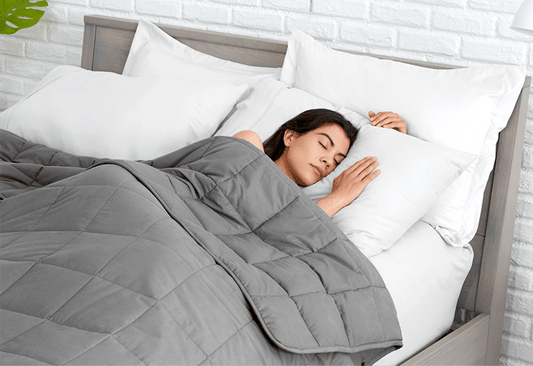
5 Fall Blankets, Sorted by the Job They Do

Match the layer to the room temperature, not the calendar month.
Fall nights are uneven. The first cool week in September is not the same job as a 50-degree November evening, and a sofa throw is not the same tool as a bed blanket. Pick by what the layer is supposed to do: hold a little air, add a nap, add pressure, or stay on you when you leave the bed.
Bare Home carries throws, weighted blankets, wearable blankets, flannel, and microplush under one OEKO-TEX Standard 100 catalog standard. Shop the construction that matches the room, then confirm fiber and weight on the specific item.
1. Keep a mid-weight throw for early fall
A standard throw is about 50 by 60 inches. That size covers a seated adult on a sofa. It is short on a queen bed unless you fold it at the foot as a third layer, not as the whole cover.
Early fall rooms often sit in the mid-60s once the air conditioning goes off and the furnace is still off. A mid-weight woven cotton or cotton-blend throw (waffle, herringbone, or a flat woven) holds a thin layer of still air without the pile that traps heat against skin.
Shop the mixed constructions together rather than hunting one fall print: Bare Home blankets and throws. Use this layer on the couch in September and October, and as the extra fold at the foot of the bed when a sheet-plus-light-duvet stack is almost enough.
2. Use a napped blanket on the couch, not as your only bed layer
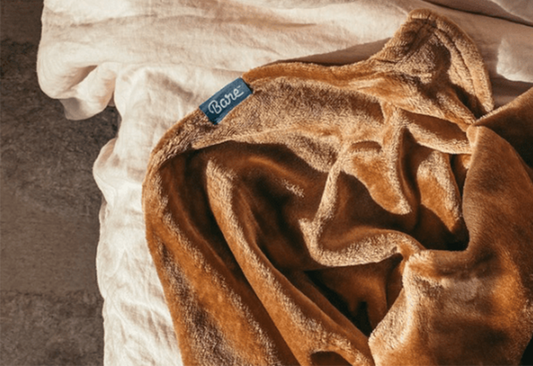
Fleece, sherpa, and microplush work by raising fibers into a nap. The raised surface traps air. That is why a thin fleece throw can feel warmer than a smoother woven of the same weight on a 55-degree porch, and why the same piece can feel muggy in a closed bedroom.
This is the part that trips people up. A napped throw is a sitting layer. On a bed it sits on top of sheets and either a lightweight insert or a quilt. If you sleep warm, keep the nap on the sofa and use a flatter weave on the mattress.
Bare Home groups the high-pile sitting fabrics under microplush and the looser throw assortment under blankets and throws. Machine-washable synthetics handle kids and pets better than dry-clean wool. They also hold heat longer, so they are a poor only layer if your bedroom still runs warm in October.
3. Add flannel when the sheets feel thin
Flannel is a woven cotton that is brushed after weaving. The brush raises a short nap. That nap is why flannel sheets and flannel blankets feel warmer than percale of similar yarn, and why they pill if you wash them hot with heavy items.
If September still wants crisp sheets and November wants something that does not feel like a cold landing, change the sheet first, then add a flat blanket. You do not need to jump straight to a winter comforter. Flannel as a middle layer lets you keep the same duvet insert and only swap the sheet and one blanket.
Start in the flannel collection for the sheet swap, then pull a separate blanket from blankets and throws if you want the extra fold without changing the whole bed.
4. Treat a weighted blanket as pressure, not insulation

A weighted blanket is filled so the mass is spread in pockets or an open knit. The useful variable is pounds relative to body weight and bed size, not how the shell looks. A common starting point is about 10 percent of body weight, then size the blanket to the sleeper, not the mattress. A 15-pound twin on one person feels denser than a 15-pound queen shared across more fabric.
Fall is when people add a weighted layer and then wake hot. Weight and insulation are different jobs. A plush or minky shell plus beads plus a duvet is three insulators. Cotton or an open knit with a removable cover is easier to run in a 66-degree room. If the cover is fleece, treat that cover as a later-fall accessory and pull it in November, not in the first cool week.
Shop the weighted blankets collection. Do not stack a weighted blanket on a high-loft comforter unless you already sleep cold.
5. Keep a wearable blanket for the hours you are not in bed
A wearable blanket is a sleeved or wrap construction so the layer stays on when you stand up. That is a house layer, not a sleep layer. Using it on the couch in the evening keeps you from dragging the bed blanket into the living room and then sleeping under whatever is left.
Fall houses are drafty in hallways and fine in closed bedrooms. The wearable solves the hallway and sofa hours. Put it back on a hook. Keep the bed stack boring and washable.
See wearable blankets.
Bringing it together
You probably want two sitting layers and one sleep adjustment, not five new products. A mid-weight throw for September evenings. A napped or microplush throw for the couch after dark. On the bed, either flannel sheets or a flat blanket over your current insert. Add weight only if you want pressure. Add a wearable only if the throw keeps migrating off your shoulders.
If the bed itself is the problem (insert too hot, sheets too cold), fix the stack before you buy another throw. Change the sheet and the duvet job first, then pick the blanket that fills the gap.
The short version
Match the blanket to the room, not the month. A September house with the furnace off is a different job from a November bedroom.
Throws cover a seated adult. About 50 by 60 inches is the common throw size. Use it on the sofa or folded at the foot of the bed.
Nap holds heat. Fleece, sherpa, and microplush trap air at the surface. They belong on the couch more often than as the only bed cover.
Flannel is brushed cotton. The brush raises a short nap, so flannel sheets or a flannel blanket warm a bed without jumping to a winter comforter.
Weight is not warmth. A weighted blanket adds mass. A plush shell on top of that mass is what overheats people in fall.
Wearable blankets stay on when you stand up. Use them for house hours so the bed stack can stay simple.
Shop The Products We're Talking About


Keep Reading
How to Layer Bedding for Fall

How a weighted blanket can improve sleep