Where Color Belongs If Sheets Stay Light

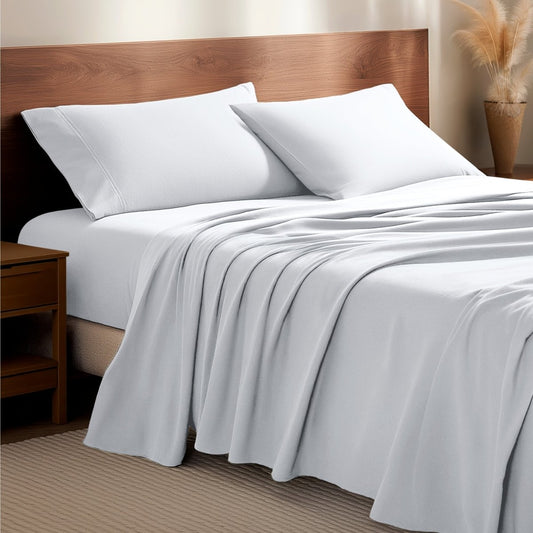
White sheets with a colored top layer is the split that holds up in real laundry, not just in a styled photo. Sheets take skin oil, sweat, and makeup every night, so a light ground makes a new stain easier to see and, on cotton, easier to treat. A duvet cover, quilt, or throw carries the color you actually look at, and you can change that piece without replacing the sheets.
Where color belongs if the sheets stay light
The bed has four places color can sit. They do not collect the same soil, and they do not go in the wash on the same schedule.
Sheets
Sheets are the layer against skin. A fitted sheet and a top sheet, if you use one, pick up body oil along the torso and pillow zone, plus lotion and hair product near the head. On white or a very light solid, a new yellow patch or a makeup smear reads immediately, which is useful: you treat it before it sets. On a dark sheet, the same oil can sit for weeks before you notice it.
That is the case for keeping sheets light even if the rest of the bed is not. Bare Home sheet sets are OEKO-TEX Standard 100 certified. Fiber and weave still decide how a stain releases. Percale is a tight plain weave. Sateen floats threads on the surface. Those are different fabrics, and care labels differ by set.
Duvet cover

A duvet cover is a washable shell over the insert, closer to a large pillowcase than to a comforter. You see almost all of it once the bed is made. You wash the cover. The insert stays out of the machine most of the time. That is the right place for the color you want in the room.
Swap the cover and the bed reads differently. The sheets and the fill stay. A duvet cover in a mid or deep solid does that job without putting the darkest fabric against your skin every night. If you want one specific set with a zipper and corner ties, the Ultra-Soft Duvet Cover Set is a cover plus shams, insert separate. Color count on that set is.
Quilt or coverlet
A quilt is a thinner stitched layer. Folded at the foot, it is the color block you see from the door. Pulled up, it is a light top on a mild night. You wash the whole piece, fill and shell together, so a quilt is a worse place for a color you cannot stand to fade, and a better place for a color you want visible without a second duvet.
The Ultra-Soft Quilt Set is that lighter layer, reversible, with shams. Construction and available colors are beyond the product name. For how a quilt differs from a comforter and a duvet, Bare Home already has Quilt vs Comforter vs Duvet.
Throw
A throw is the smallest colored piece and the easiest to wash on its own. Fold it across the foot on top of a light cover. If a pet, a snack, or a damp coat lands on the bed, this is the layer you can pull off without stripping sheets. The Cable Knit Faux Shearling Blanket is one blanket, cable face and plush back, meant to sit at the foot or on a chair. More throws live in blankets and throws.
What color changes in the wash
Color does not make a fabric cleaner. It changes what you can see, and what chemistry you can use on it.
Stain contrast
A stain shows when its color is different from the ground. Body oil and sweat oxidize toward yellow and brown. On white sheets that shift is obvious, which is why white bedding is the one people accuse of "turning yellow." The oil was there on a navy sheet too. The ground hid it. Makeup, blood, and food sauce also read faster on white. Lint, dust, pet hair, and dried deodorant show faster on black, charcoal, and deep navy.
A middle value, sand, sage, or a heather, hides both families better than either extreme. It will not stop the soil. It only delays the moment you notice it.
Bleach and brighteners
Chlorine bleach is a whitener and a disinfectant in the laundry sense, and it strips dye. That is why a white cotton sheet can often take a bleach soak that would ruin a burgundy cover. Oxygen bleach is the usual alternative on colors, and it is slower. Hot water sets protein stains and can fade dye. Cold water is the safer default until you have read the label on that set.
Fade and lint
Dark and saturated dyes fade in sun and in repeated hot washes. A cover that lives in a bright window will shift before the sheets do, because it is the face of the bed. Light solids show pills and gray soil in the wash water more honestly. Dark solids hide that soil and collect visible lint from towels if you wash them together.
Wash the cover or throw with like colors the first few cycles. A new deep cover can release dye onto a white sheet in the same load. That transfer is a laundry problem, not a reason to avoid color on the bed.
White sheets with a colored top layer
Use white or a light solid for the pieces you wash every week. Use color on the piece guests see.
The practical split
Keep the fitted sheet, top sheet, and pillowcases light. Put the room color on the duvet cover or the quilt. Add a throw if you want a second color without buying another large piece. You then own one sheet color in a couple of sets, and you rotate covers. Extra sets matter more on the sheets than on the top layer, because the sheets are what actually need a spare while one is in the machine.
If you sleep directly under a comforter with no top sheet and no cover, that comforter is doing the sheet job. Color on that piece will hide oil the same way a dark sheet does. A cover you can wash is the cleaner fix.
When white on top still makes sense
An all-white bed is still a reasonable choice if you want one wash routine, if you use bleach on cotton, or if you are furnishing a guest room and do not want to track which cover goes with which sheets. White on white also hides the mismatch when a sham and a sheet set come from different lines. The tradeoff is visual: the bed relies on texture, a quilt fold, or a throw, because there is no color contrast to read from the doorway.
The short version
Sheets take the soil. Skin oil, sweat, and makeup land on the fitted sheet and pillowcases, so a light sheet makes a new stain easier to see.
Color belongs on the cover, quilt, or throw. Those layers are what you see once the bed is made, and you can swap them without replacing the sheets.
Dark hides yellowing and shows lint. White does the opposite. A mid tone hides both a bit longer and does not clean either one.
Bleach is a white-cotton tool. Chlorine bleach strips dye. Read the care label before you treat a colored cover like a white sheet.
A throw is the small color change. One washable blanket at the foot adds a second color without a second duvet.
Match the wash to the layer. Sheets need a spare set. Covers and throws need like colors in the machine so a new dye does not move onto white.
Shop The Products We're Talking About


Keep Reading

Styling Sherpa Blankets on Your Bed

Warm Bedding for Fall: What to Add