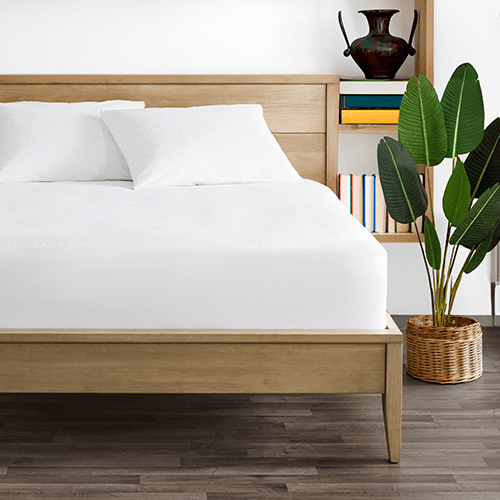
What Makes a Hotel-Style Bed Beyond Soft Sheets

A hotel-style bed is not defined by softness. Most luxury hotels use cotton percale in a moderate thread-count range, finished with a tightly made flat sheet, a separate duvet system, and multiple pillows. The crisp, cool surface you notice comes from the plain weave and the tension of the making, not from a high thread count or a silky hand.
The percale weave hotels actually choose

Percale is a plain weave: one warp thread over one weft thread, then under the next, repeating in a balanced grid. That frequent interlacing produces a matte surface with more open structure between the yarns than a float weave. Air moves through more readily, which is why the fabric reads as cool and crisp rather than warm and drapey.
Sateen, by contrast, floats three or four yarns over one before interlacing. Those longer floats create the smooth, slightly lustrous hand many people associate with soft sheets, but they also reduce air permeability and snag more easily under heavy use. Hotels largely avoid sateen for everyday guest sheets because the percale structure holds up better to commercial laundering and delivers the signature cool, structured feel. Thread counts in hospitality typically sit in the 200 to 400 range of single-ply long-staple cotton. Higher counts often come from multi-ply yarns that pack density without improving breathability or durability under repeated hot washes.
Bare Home carries percale in the Percale Collection.
The layers that create the envelope
Hotels treat the bed as a sequence of layers rather than a single set. A common order is a fitted sheet over any topper or pad, a flat top sheet tucked with hospital corners, and a duvet cover with a separate insert rather than a quilted comforter. The flat sheet, folded and tucked, forms a clean envelope that keeps the duvet cover cleaner and adds a light, adjustable layer. Hospital corners start by placing the flat sheet so it hangs evenly, then folding the foot corners into a 45-degree triangle and tucking the excess tightly under the mattress. The tension from that tuck is what produces the taut surface and the faint paper-like rustle when you slide in.
A separate duvet cover lets the outer layer be washed frequently while the insert stays in place for years. The cover drapes more loosely than a sewn-through comforter, which contributes to the fuller loft people notice in hotel rooms. Bare Home sells duvet covers and duvet inserts as separate pieces so you can match the cover weave to the sheets if you want a consistent hand across the bed.
Pillows and the finishing details
Four pillows are common in hotel rooms: usually a mix of firmer and softer fills so a guest can stack or separate them to suit sleep position. The visual stack signals completeness, and the variety reduces the chance that a single pillow height will feel wrong. Cases match the sheet fabric so the entire surface launders the same way. Decorative shams or Euro squares sit in front for the made-bed look and come off for sleep. Bare Home offers pillowcases and shams across the collections, including percale options.
White remains the default in most hotels because it signals cleanliness, accepts bleach or oxygen brighteners without dye issues, and photographs uniformly. At home the same choice keeps the bed looking freshly made longer between washes. Care that supports the crisp surface includes skipping fabric softener (it coats fibers and reduces absorbency) and ironing or steaming the flat sheet if you want the pressed finish hotels achieve with industrial mangles. Home dryers cannot fully replicate that finish, so the weave and the tight tuck do more of the work once the sheets are dry.
The short version
Percale is the hotel weave. A one-over-one plain weave produces the cool, matte, structured surface hotels use, not a float weave or a high thread count.
Moderate thread count is the practical range. Most hotels specify roughly 200 to 400 single-ply long-staple cotton because denser counts reduce breathability and wear faster under hot washing.
The flat sheet and hospital corners create the envelope. Tight tucking of an oversized flat sheet adds tension and a clean barrier layer that a fitted sheet alone does not provide.
A separate duvet cover outperforms a quilted comforter for the hotel look. The cover washes independently, drapes more loosely, and keeps the insert protected.
Multiple pillows and white fabric finish the system. Four pillows in mixed firmness plus matching white cases deliver both function and the visual standard.
Shop The Products We're Talking About


Keep Reading
How Long Do Sheets Last (by Fabric Type)
What “Breathable” Actually Means on Bedding