Quilted vs Cotton Terry Mattress Protector

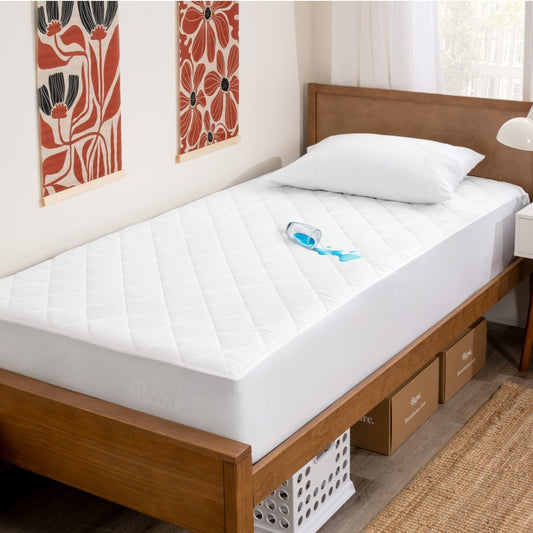
A quilted mattress protector and a cotton terry one are both fitted barriers if the product is built as a protector. The quilted face is a stitched panel with a little loft. The terry face is looped cotton, closer to a light towel, so surface moisture sits in the loops instead of on a flat weave. You pick the face for what you feel through the sheet. You pick the barrier for whether a spill can reach the foam.
What the face is doing
A protector is a fitted cover with a barrier laminated to the back. The barrier is why a glass of water does not finish in the mattress core. The face is the fabric on your side of that film. Sheets sit on the face, so the face is most of what you notice after the first night.
Bare Home groups both styles in mattress pads and protectors. OEKO-TEX Standard 100 applies across the catalog, including these layers. That certification is about tested substances in the finished item. It does not tell you which face will sleep cooler.
Quilted panel

Quilting is stitching that holds a thin fill or a padded top in place, usually in a diamond or channel. The stitches create a slight air gap between you and the film. That gap is why a quilted protector can feel less like plastic under a percale sheet, and why it also adds a little height and a little insulation.
The tradeoff is bulk. More loft means more fabric to wash, a taller stack for the fitted sheet, and more material that can shift if the quilting is loose. A quilted protector is still a protector if the film is continuous. It is not a mattress pad. A pad’s first job is loft. A protector’s first job is the barrier, with quilting as the face.
Terry loops
Terry is a weave that leaves uncut loops on the surface, the same idea as a bath towel, just lighter on a bed. Loops hold a small amount of sweat or a drip on your side of the barrier, then release it in the wash. A flat face leaves that moisture sitting on the film until the sheet takes it.
Loops also change the hand. They feel drier at first contact than a smooth laminated face, and they can hide the crinkle of the film better than a thin jersey. They flatten, snag, and pill if you wash them hot with towels or dry them until the loops crisp. That wear is the face, not a failed barrier.
Quilted vs cotton terry mattress protector
Shop the pair as two answers to the same spill problem. The difference shows up in feel, heat, noise, and how the surface looks after a few months of washing.
Feel under the sheet
Through a cotton sheet, the quilted protector reads as a thin padded layer. Hips and shoulders meet a stitched surface instead of a flat film. The cotton terry protector reads as a dry, looped cotton, with less of that padded give. If the mattress already feels hard at first contact, the quilted face is the one that changes the surface. If the complaint is a clammy or plasticky hand, the terry loops are the part that changes it.
The Clean Classic Memory Foam Mattress is 11 inches tall, with a breathable knit cover over the foam. A protector still sits on top of that cover. The cover is washable. The foam under it is not where you want a spill.
Heat and noise
Both faces can sit on a waterproof film, and the film is the part that slows vapor. Body heat and sweat stay on your side of the barrier instead of moving into the mattress. That is the warm feel people blame on the protector, especially on memory foam, which already holds heat. A quilted panel adds a second reason to sleep warmer: the loft traps a thin air layer. Terry does not add that pad of air. It can feel less sealed at the surface because the loops take up moisture, even while the film underneath still blocks a soak.
Noise is the film flexing, not the quilting or the loops. A stiff membrane, or a protector with extra slack, crackles when you roll. A terry or quilted face can muffle that sound. It does not remove it. A first wash often relaxes a new film. If it still pops after two washes and a snug fit, the membrane is the noisy part.
Wash and wear
Wash the protector after a spill, and on a normal cadence if someone sleeps hot or the bed gets shared. Cold or warm water is the safer default until the care label says otherwise. High heat can set stains, shrink a cotton face, and stiffen a film. Skip fabric softener. It coats loops and can affect a laminated back.
Terry shows wear in the loops: flattening on the hip line, light pilling, a towel texture that goes smooth in the center. Quilted wear shows up as shifted fill inside a stitch diamond, or loose threads at a seam. Neither one means the barrier has failed. A failed barrier is liquid reaching the mattress, or a film that has cracked and peeled. Retire the protector then, not when the face looks used.
Fit on the stack
Measure stacked height, not the mattress box. Order is mattress, protector, then fitted sheet. If you also use a pad, the pad goes above the protector. Bare Home pocket bands are Standard for 7 to 14 inches, Deep for 15 to 17 inches, and Extra-Deep for 18 to 25 inches or more, including pillow-tops and toppers.
An 11-inch mattress alone sits in Standard. A quilted protector adds more height than a thin terry one, so a mattress already near 14 inches can leave Standard once the quilted layer is on. Remeasure after it is fitted. If the sheet pops at the corners, the band is short. Move to extra-deep pocket sheets when the stack is 18 inches or more. Everyday sets live in the sheets collection.
Size the protector to the mattress, not to the sheet. A deep-pocket protector on a thin mattress will slop, and slack is what makes the film noisy. Split King is two Twin XL surfaces. A King protector will not fit one side of a split.
Choosing between the two
Choose the cotton terry protector if you want a drier cotton hand and you do not need extra loft under the sheet. It is the simpler face when the mattress already feels right and the only job is spills plus a less plastic surface.
Choose the quilted protector if the mattress feels flat or hard at first contact and you want a thin padded panel without adding a separate pad. Expect a little more height and a little more warmth from that loft. If you already sleep hot under a waterproof layer, do not add a pad on top of the quilted face. Change the sheet weave or the duvet before you stack another insulator.
Use one protector, not both. Two barriers trap more heat and add two skirts to fight at the corner. If the room is the problem at 5 a.m., fix the layer above the sheet.
The short version
The face is not the barrier. Quilted stitching and terry loops change what you feel. The film, if the product has one, is what stops a spill.
Quilted means a thin pad. You get a little loft and a little extra height. That loft also holds a bit more heat.
Terry means loops. Surface moisture sits in the cotton loops. The hand is closer to a light towel than to a quilted panel.
Noise is the film. A quilted or terry face can muffle crackle. A loose fit makes it worse.
Measure the stack. The Clean Classic is 11 inches before the protector. Quilted adds more height than a thin terry face.
One protector is enough. Do not stack the quilted one and the terry one. Pick the face that matches the complaint.
Shop The Products We're Talking About


Keep Reading
Mattress Pad vs Protector: What Goes on the Bed
Mattress Pad vs Mattress Topper: Which Bed Upgrade Is Right for You?