Warm Bedding for Fall: What to Add

1. Change the sheet before the comforter
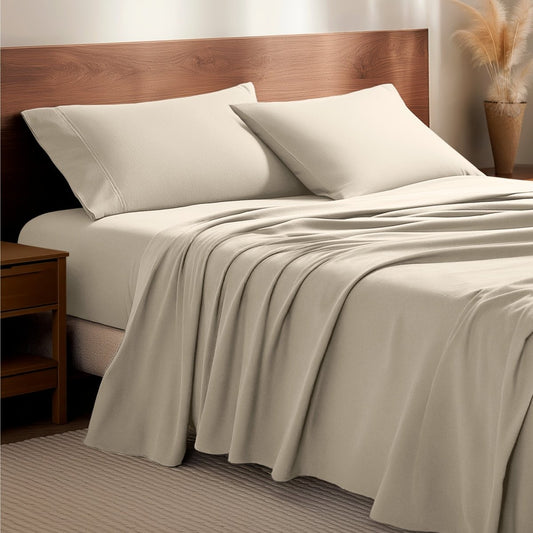
The sheet is the fabric on your skin. If the room is cool and the sheet is a smooth sateen or a light percale, you feel that first, before the comforter has a chance to matter. Fall is when a brushed cotton sheet earns its place.
Flannel is cotton that is brushed after weaving, so short fibers stand up on the surface. That nap traps a little air and feels warmer than a plain weave of the same fiber. It also pills more easily, because those raised fibers rub. A jersey sheet is knit, like a T-shirt, and feels soft without that brushed nap. Microplush is a different surface again, denser and less breathable. [
If you sleep warm even in October, keep the cooler sheet and add warmth above it. If your feet are cold before the rest of you, the sheet change does more than a heavier comforter. Flannel sheets are in the flannel collection. Jersey is separate: jersey sheets. Microplush is here: microplush sheets.
2. Keep a blanket you can pull up
A blanket is the adjustable layer. It should cover the mattress top, not just the foot. You pull it up when the room drops and push it down when you heat up. That is the job a comforter cannot do, because taking a comforter off means getting up.
Put the blanket over the flat sheet and under the duvet, centered, with the same overhang on both sides. If you skip the flat sheet, the blanket becomes the washable middle. Wash it more often than the comforter and less often than the sheet.
A throw is smaller. Use it across the foot or over your legs on the couch. Do not expect a throw to replace the middle blanket on a Queen or King. Blankets and throws are in blankets and throws.
This is the part that trips people up. A fall photo stacks sheet, quilt, comforter, and throw. You sleep under one or two of those. The extra pieces stay at the foot until you reach for them.
3. Use a duvet cover so the warm layer is washable

A duvet is an insert inside a cover. A comforter is the filled piece itself. Both can be the warm top layer. The cover is what you wash. The insert stays out of the machine most of the time.
For fall, a cover you can swap is more useful than a second comforter. A lighter cover in cotton percale still breathes. A heavier cover, or a flannel cover, holds more air at the surface. The insert does the loft. Down alternative is a synthetic fill. It does not come from birds. It also does not regulate the way down does, and it can feel warmer if the shell does not breathe.
Covers are in duvet covers. Inserts are in duvet inserts. A single filled top, with no separate cover, is in comforters and quilts.
Shake the insert, match the corners to the ties or zipper, and smooth from the center. An insert a few inches larger than the cover fills the corners. An insert much larger than the cover bunches. Fold the top third down in the morning if you want the blanket visible. Leave it up on cold nights.
4. Match the top layer to the mattress size
Warmth fails when the top layer does not cover you. A Queen insert on a King leaves a gap at the side, and the person on that side steals the covers. A King cover on a Queen hangs farther and looks fuller. It is also heavier to manage.
A King mattress is wider and shorter than a California King. Common cuts are about 76 to 78 inches by 80 inches for King, and 72 by 84 inches for California King. Many covers are labeled King/Cal King as one size. Fitted sheets are not interchangeable across those two beds. Check the listed cut of the cover against the mattress before you assume the drape will match.
Split King is two Twin XL mattresses. A single King sheet will not fit that split. Top-of-bed pieces sometimes still work across the pair if you want one shared duvet. If you sleep at different temperatures, two Twin XL duvets on one King let each person set a layer. Pillows do not fix a short comforter. They only hide it in a photo.
5. Add a throw or wearable only for the evening
The bed does not have to do every cold hour. A wearable blanket is for sitting up, reading, or the first half hour before you get under the duvet. It is not a substitute for a fitted sheet or a duvet sized to the bed. Wearable blankets are in wearable blankets.
A weighted blanket is a pressure layer, not a warmth rating. The same listed weight feels heavier on a smaller size, because the mass sits on less area. Bare Home lists a cotton weighted blanket and a minky fleece weighted blanket. Use it as its own layer. Do not stack it under a thick comforter if you already run warm. Weighted blankets are in weighted blankets.
Every Bare Home item is OEKO-TEX Standard 100 certified. That is a harmful-substance test for the item. It is not a warmth claim. Select products are GOTS certified. That does not extend to the whole catalog.
If you only need warmth before sleep, stop at this layer. Do not buy a heavier insert for a problem that lasts twenty minutes.
Bringing it together
Pick the cold spot, then the layer. Cold skin means the sheet. Cold after you have been in bed means the middle blanket or a warmer insert. Cold only while you read means a throw or a wearable, not a new comforter.
There is no warm-bedding collection URL in the approved facts file. The fall shops that are listed are flannel, blankets and throws, and duvet covers. Use those three before you add a second top layer.
The short version
Fall warmth is a layer you can remove. Change the sheet, the blanket, or the top layer. Do not replace all three at once.
Flannel is brushed cotton. The nap feels warmer than a plain weave and pills sooner because those fibers rub.
A blanket is the adjustable layer. A throw is too small to cover a Queen or King on its own.
A duvet cover is the washable warm layer. The insert stays out of the washer. A comforter is the filled piece with no separate cover.
Size beats weight. A top layer that does not hang past the mattress sides leaves someone cold, no matter the fill.
A wearable or weighted blanket is not the bed. Use it for the evening, or as its own layer, not as a second comforter.
Shop The Products We're Talking About


Keep Reading
5 Fall Blankets, Sorted by the Job They Do
Guest Room Bedding for Fall Weekends