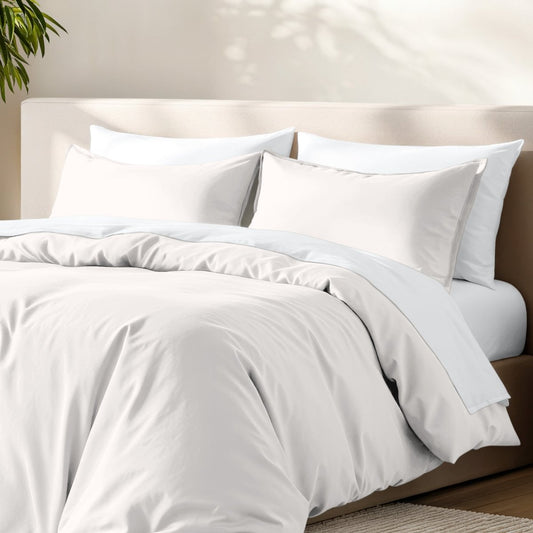
Down vs Down-Alternative Inserts When Nights Drop

What down fill does overnight
Down clusters are three-dimensional. Each cluster holds many small air pockets. Those pockets are what insulate. Fill power (a lab measure of loft per ounce) tells you how much volume a given weight of down can occupy. Higher fill power means more trapped air for less weight.
That is why a light-looking down insert can still run warm. The heat stays in the pockets until it finds a path out. In a dry, cold room that path is slow, which is the point. In a heated bedroom, or on a humid night, the same structure can feel muggy because down does not move moisture as readily as some plant fibers.
Down also compresses and recovers. You can pack it small. You usually cannot toss the insert in a home washer without a large machine and a careful dry.
What down-alternative fill does overnight
Down-alternative inserts use polyester fibers formed into clusters or a continuous loft, then held in channels or boxes so the fill cannot slide to one end. The insulation logic is the same: trapped air. The fiber itself is different.
Polyester does not absorb much moisture. Sweat sits on the fiber or in the cover fabric instead of inside the fill. That can feel drier to some sleepers and clammy to others, depending on the duvet cover you put over it. A percale or linen cover lets more air through the envelope. A brushed or sateen cover holds more warmth at the skin.
Most down-alternative inserts are built for a home washer and dryer. Box stitching keeps the footprint of the insert closer to the cover's seams, which is useful when you change the cover as nights cool.
Choosing for shoulder-season nights
Start with the room, then the fill
If the bedroom still sits in the high 60s at 11 p.m., a mid-weight down-alternative insert plus a cotton cover is usually enough. You add a quilt or comforter at the foot of the bed for the 4 a.m. dip, and you kick it off without re-stuffing the duvet.

If the room regularly drops into the low 60s, the fill type matters less than stacking: one insert you already own, then a second layer you can remove. Two lighter layers beat one heavy bag you cannot escape at 2 a.m.
Down vs down alternative, in use
Down gives more loft per ounce. That is the "cloud" feel. It is also the fill that overheats first if your heat stays on and the cover is dense.
Down alternative is heavier for the same loft. It holds a flatter, more even panel in the cover. It is the easier wash. It will not match the lightest high-fill-power down for warmth-to-weight, and it does not need to if you layer.
Do not buy on the word all-season alone. That label is not a lab rating. Compare the insert's listed weight by size and how the cover fabric breathes.
The short version
Air pockets do the warming. Both fills trap air. Down clusters do it with less fiber weight. Polyester clusters do it with a washable, box-stitched panel.
Cover fabric changes the result. The same insert sleeps warmer under sateen or flannel than under percale or linen.
Shoulder season wants a removable layer. Keep a quilt at the foot of the bed instead of jumping to the heaviest insert in September.
All-season is a marketing name. Read the insert weight and your bedroom temperature. The tag will not do that work.
Shop The Products We're Talking About


Keep Reading

Should You Buy a Duvet Insert Larger Than the Cover?
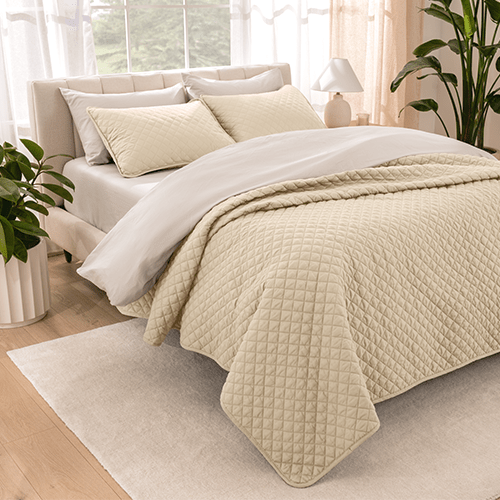
Quilt vs Comforter vs Duvet: What’s Different